
Basic Baccarat Strategy Game Introduction
As one of the simplest casino games, Baccarat has only three betting options—Player, Banker, or Tie. It seems like the game is easy to learn and play, while the outcome is based on luck, there are still some Baccarat tips and tricks to improve your win rate.
Understanding the rules, odds, and money management strategies before you start will improve your win rate and help you build up confidence to play Baccarat.

How To Play Baccarat Game
As we mentioned, Baccarat has the simplest gameplay in an online casino. Here are 5 points for you to learn how to play the Baccarat game:
- Player and Banker each get two or more cards.
- Cards 2–9 = face value; 10s and face cards = 0; Aces = 1.
- If the total is above 9, drop the first digit (e.g. 9+6=15 → 5).
- Sometimes a third card is drawn, but you don’t decide—casino rules handle it automatically.
- Closest hand to 9 will win.
Baccarat Odds & House Edge
Each bet has its own odds and edge:
- Banker – Wins ~45.8% of hands. House edge: ~1.06% (with 5% commission). Best bet long-term.
- Player – Wins ~44.6% of hands. House edge: ~1.24%. Slightly worse than Banker, but no commission.
- Tie – Wins less than 10% of hands. House edge: ~14%. Tempting payout (8:1) but a bankroll killer.
The numbers make it clear: avoid Tie bets and stick with Banker for consistent play.
Banker vs Player Bets
- Banker Advantage: Banker wins slightly more because of the third-card rule. Even after the 5% commission, it’s still statistically the smartest bet.
- Player Advantage: If you want pure payouts, Player bets return your full winnings without commission. Some prefer this for simplicity.
- Both bets are close, but most seasoned players lean toward the Banker.
While a Tie pays 8:1, the math doesn’t add up. Over time, you’ll lose more than you win. Betting on a Tie is fine occasionally for fun, but never build a strategy around it.
Card Counting in Baccarat
Unlike Blackjack, baccarat decisions are out of your hands once you bet—but some try card counting to gain a tiny edge. Here’s the system in short:
- +1 for Aces, 2s, 3s.
- +2 for 4s.
- -1 for 5s, 7s, 8s.
- -2 for 6s.
- 0 for 9s, 10s, and face cards.
If the count hits +16 or higher, Player bets are slightly favored. Below that, stick with Banker. It’s not foolproof, but some players enjoy using it for guidance.
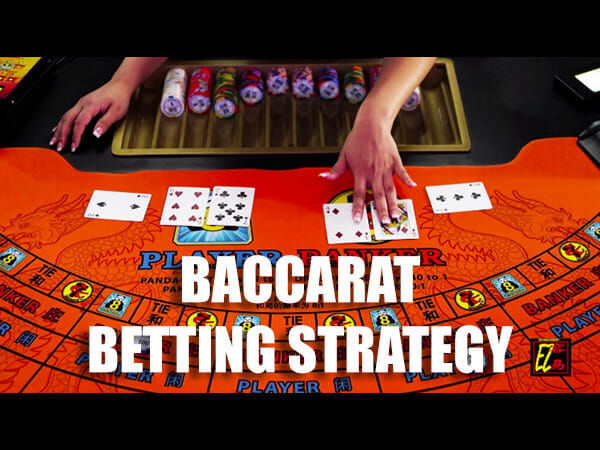
Basic Baccarat Strategy
Beginner’s luck makes many players reckless. They win early, keep betting, and end up leaving with nothing. The key is bankroll management: knowing how much to bet, when to stop, and when to walk away. Here are some basic Baccarat strategies based on betting for you to learn how to place your bets.
- Flat Betting – Same bet every round. Safer and steady, good for casual play.
- Martingale (Double-Up) – Double your bet after a loss. The risk: you need a huge bankroll and table limits may stop you. Net profit is only your base bet.
- Press When Winning – Increase bets after wins, reduce after losses. Works well if you catch a winning streak early.
- Hybrid System – Bet the same after losses, raise stakes only after wins. Balanced and less risky.
Example: 1 unit → 2 → 3 → 6 → 4 → 8 (reset to 1 unit if you lose). This lets you capitalize on streaks while limiting damage during losing runs. - Reduced Betting Strategy: Divide the bankroll into 10 parts. Start high, then reduce as you win: 4 units → 2 → 1. If you lose, scale down slowly. This method works well for short sessions where you don’t want to risk everything.
Basic Baccarat Strategy Takeaway
- Learn the rules before betting.
- Stick to Banker bets for consistency.
- Avoid Tie except for the occasional gamble.
- Set a stop-loss and take-profit before playing (e.g. quit after winning 1.5× your buy-in).
- Don’t chase patterns—each hand is independent.
- Short sessions are safer than staying long at the table.
- Only play with money you’re comfortable losing.
Baccarat is a game of chance, not skill. Once you place your bet, the outcome is out of your hands. But by understanding the rules, making smart bets, and practicing bankroll management, you can extend your playtime and give yourself the best shot at leaving ahead.
Whether you’re playing casually or aiming for consistent wins, remember this: baccarat isn’t about beating the house every time—it’s about playing smart, managing risk, and knowing when to walk away.
Baccarat Strategy